
Google Ads vs Meta Ads: Which One Should a Small Business Run?
Almost every business owner I talk to asks some version of the same question. Which one should I be running, Facebook or Google?
It's a fair question and I understand why it gets framed that way. Ad budgets are finite, and picking one feels simpler than splitting the difference. The trouble is that the two platforms are answering completely different questions, so comparing them directly tends to produce a bad decision no matter which one you land on.
I want to note up front that the benchmark numbers below come from public industry reports, and they vary quite a bit depending on who published them. I'll flag where that matters.
What is the actual difference between Google Ads and Meta Ads?
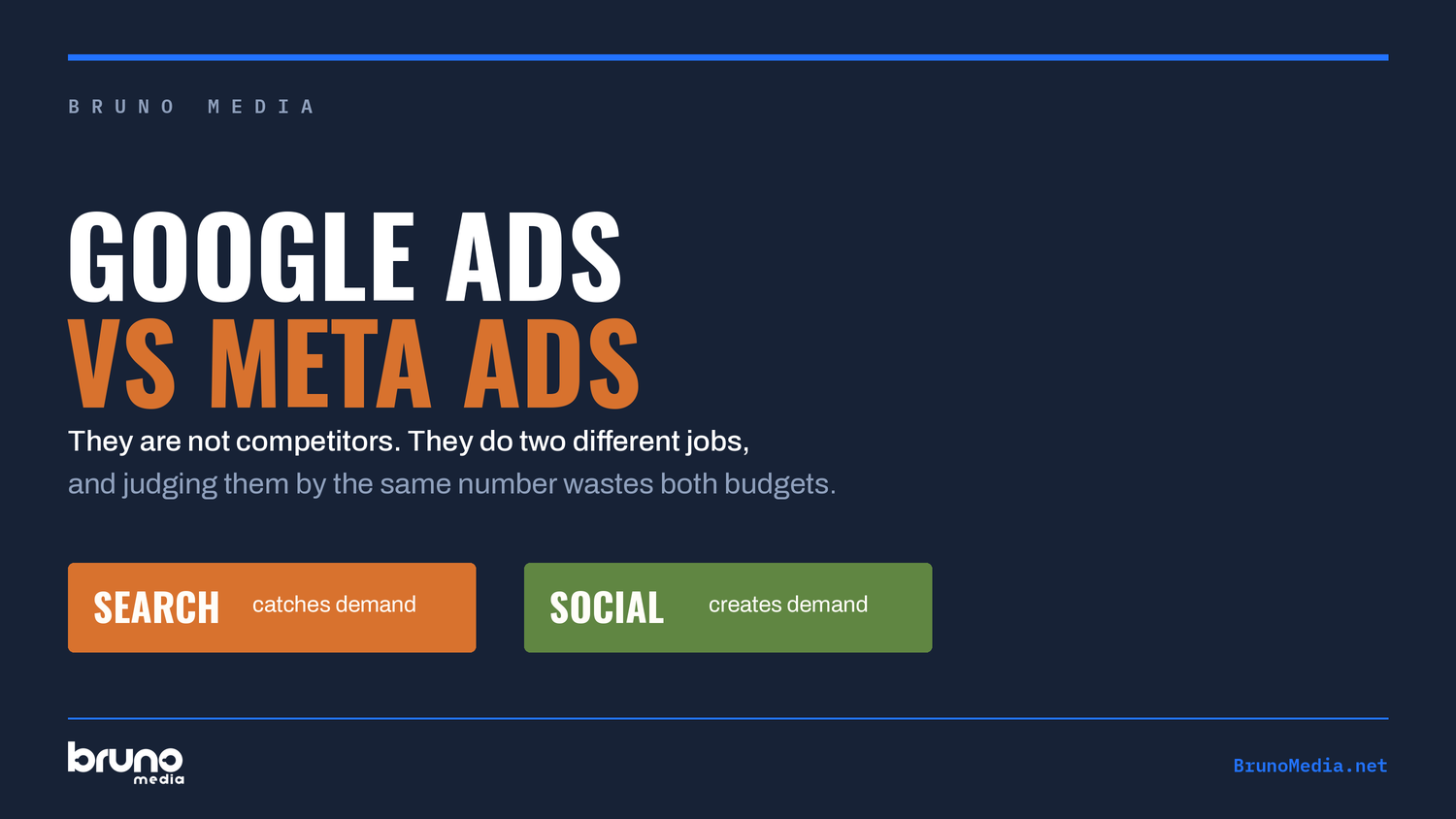
Google Search catches demand that already exists. Somebody pulled out their phone, typed "kayak tours near me," and is sitting there with a decision half made. Your ad shows up at the exact moment they were already looking.
Meta creates demand that wasn't there yet. Nobody opens Instagram thinking about axe throwing. They were scrolling past a friend's vacation photos, and your video put an idea in their head that wasn't there ninety seconds ago.
Those are two genuinely different jobs, and one of them captures intent while the other manufactures it from nothing.
This is also why the "which one is better" framing falls apart. Asking whether Google beats Meta is a bit like asking whether a fishing net beats bait. They work on different parts of the same problem.
Which platform is cheaper?
Meta is cheaper on a per-click basis, and it honestly isn't close on the surface.
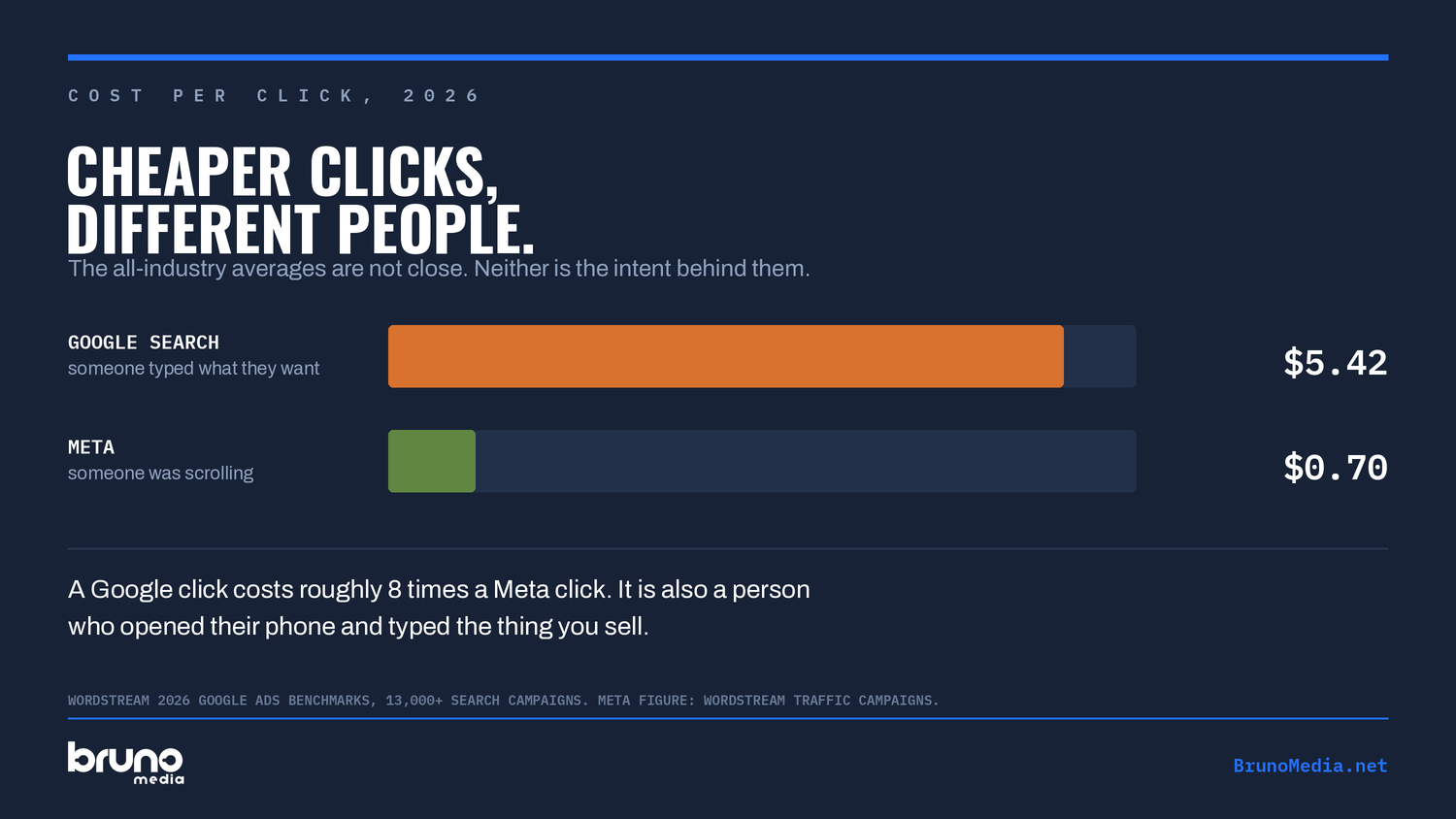
WordStream's 2026 benchmark report puts the average Google Search cost per click at $5.42 across 23 industries, measured from more than 13,000 campaigns between April 2025 and March 2026. Meta traffic campaigns average around $0.70.
So a Google click costs roughly eight times a Meta click. That sounds damning until you look at who you're buying.
The Google click is somebody who typed the thing you sell into a search bar. The Meta click is somebody who was looking at something else and got interrupted. Both have value. They are not the same click, and paying eight times as much for a person with their wallet already out is frequently the better deal.
I'd treat all of these numbers as directional rather than precise. Other 2026 reports put the Google average anywhere from $2.69 to $5.42 depending on their sample and methodology. That's a wide spread, and it mostly reflects which industries and campaign types each study included.
Is Google Ads too expensive for a small local business?
Probably not, and this tends to be the part most owners get wrong when they write Google off early.
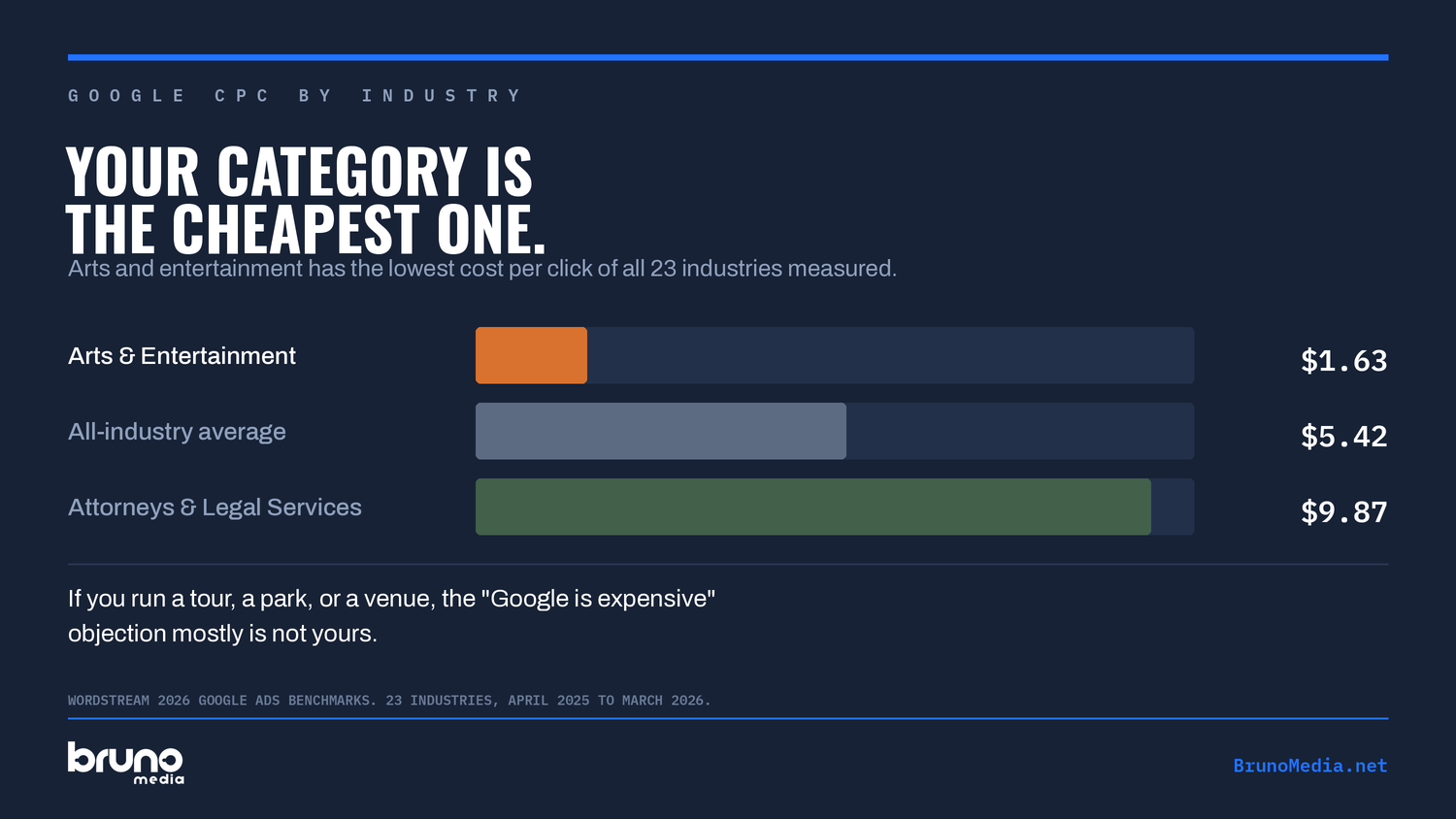
That $5.42 average is dragged upward by a handful of brutal categories. Attorneys and legal services sit at $9.87 per click. Meanwhile, arts and entertainment is the CHEAPEST category of all 23 measured, at $1.63.
If you run a tour company, an adventure park, a venue, or anything else people book for fun, that's your category. You are in the cheapest room in the building, and the sticker shock everybody warns you about is mostly somebody else's problem.
Conversion rates also moved in the right direction. WordStream found that conversion rate improved in 87% of industries in 2026, and the all-industry average now sits at 8.18%. Cost per lead actually fell for the first time in five years.
Should a small business run both?
In most cases, yes. My recommendation would be to think about it as two halves of the same picture rather than two options competing for the same dollar.
Here's roughly how it plays out.
Meta plants the idea with people who were not actively looking, which creates demand.
Google Search catches people who ARE actively looking, which captures demand.
Run Meta alone and you create interest that somebody else's search ad converts.
Run Google alone and you only ever compete for the small slice of people already searching.
The businesses I see struggle the most are usually running one of these platforms reasonably well and the other one not at all, which leaves half the funnel doing nothing.
How should I split the budget?
There is no universal answer here and anybody who gives you one is guessing. That said, an even split is a reasonable starting point for a local business with a modest budget.
If you're spending $400 a month, $200 to each is a sensible place to begin. It's enough to get real data out of both without either one starving.
From there, a few things worth watching:
Seasonality. In a peak month when people are already searching, Google deserves more. In a slow month when demand needs building, Meta earns its keep.
Ticket size. Higher-priced bookings tolerate a higher cost per click, which favors search.
Your existing search visibility. If you already rank well organically for your main terms, Google ads have less lift to provide.
If you run a split for 60 days and the numbers clearly favor one side, adjust accordingly. That's the whole point of running both long enough to learn something.
How do I know which one is working?
This is where most small accounts fall apart, and it's usually not the ads' fault.
If you judge both platforms on last-click conversions, Google will always look like a genius and Meta will always look like a failure. That isn't a performance gap so much as an attribution artifact. Meta did the work of putting you in somebody's head three days before they searched your name, and last-click gives Google full credit for it.
Set the expectation before the first report:
Google Search: judge on cost per booking or cost per lead. Direct attribution works here.
Meta: judge on reach, cost per click, and assisted conversions. Also watch for the lift in branded searches, which is the quiet signal that awareness is landing.
One practical note on the Google side. WordStream's analysis of over 15,000 accounts found that adding a single negative keyword to a search campaign can triple its conversion rate. If your search spend feels wasteful, the keyword list is usually where the leak is, well before the bids are.
The short version
Meta clicks are cheaper and Google clicks tend to convert faster, but neither of those facts is a good reason to skip the other platform entirely.
If you sell an experience that people book on a Saturday, you need both the person who searched for you and the person who had never heard of you on Wednesday. Those are different customers and they arrive through different doors.
Run both. Measure them differently. Adjust after 60 days.
Bruno Media handles paid ads, social, and email for small and local businesses across Southwest Florida. One person, real results, no junior account managers.
Your Marketing, Simplified.
Sources
WordStream 2026 Google Ads Benchmarks. 13,000+ search campaigns across 23 industries, April 2025 to March 2026.
WordStream Facebook Ads Benchmarks, traffic campaign averages.
WordStream analysis of 15,000+ accounts on negative keywords.
